


Spring Boot is powerful, flexible, and quick to get started with — but it's also easy to misuse. From bloated controllers to silent performance killers, small mistakes can snowball fast in production.
Spring Boot best practices encompass a range of strategies for building robust, maintainable, and scalable applications. Whether you're building microservices, APIs or full-stack Java applications, these 12 Spring Boot best practices will help you write cleaner, faster, and more scalable code.
Let's dive in !!!
1. 🚀 Use Constructor Injection (Not Field Injection)
Why it matters: Constructor injection is more testable, immutable, and makes dependencies explicit.
// ✅ DO THIS
public class UserService {

    private final UserRepository repo;

    public UserService(UserRepository repo) {
        this.repo = repo;
    }
}
Avoid using @Autowired on fields — it hides dependencies and complicates testing.
2. 🧼 Keep Controllers Thin, Services Fat
Why it matters: Controllers should delegate logic, not contain it.
// ❌ Don't mix HTTP logic with business logic
@GetMapping("/pay")
public String pay() {
    // payment + logging + validation logic = bad
}


// ✅ Delegate to a service layer
@GetMapping("/pay")
public String pay() {
    return paymentService.processPayment();
}
Follow proper Separation of Concerns (SoC).
3. 🧩 Use Profiles for Environment-Specific Configuration
Why it matters: Don't hardcode dev or prod values.
# application-dev.yml
server.port: 8080

# application-prod.yml
server.port: 80
Then activate via:
-Dspring.profiles.active=prodUse profiles for toggling features, URLs, DBs, etc.
4. 🧪 Write Tests with @SpringBootTest + Mock Services
Use:
@SpringBootTestfor integration tests@WebMvcTestfor controller layer@MockBeanto isolate logic
Bonus: Use Testcontainers for realistic DB testing.
5. 📏 Limit What You Autowire
Avoid autowiring internal Spring beans you don't fully understand. Instead, write your own abstractions and expose only what your service needs.
Too much
@Autowired= tight coupling.
6. 🐘 Use Flyway or Liquibase for DB Migrations
Manual SQL changes in production? Recipe for disaster.
Instead, use:
- Flyway: simple versioned SQL
- Liquibase: YAML/XML-driven migrations.
Ensure version control for schema changes.
7. 🐛 Handle Exceptions Globally
Use @ControllerAdvice and @ExceptionHandler to centralize error handling.
@ControllerAdvice
public class GlobalExceptionHandler {

@ExceptionHandler(NotFoundException.class)
    public ResponseEntity<String> handleNotFound(NotFoundException ex) {
        return ResponseEntity.status(404).body(ex.getMessage());
    }
}
✅ Consistent API errors ✅ Better logs ✅ Easier debugging
8. 🧹 Use DTOs to Avoid Entity Leaks
Don't expose JPA entities directly in controllers. Use DTOs (Data Transfer Objects).
Why?
- Prevent over-fetching
- Avoid LazyInitializationException
- Secure internal data (like passwords, IDs)
9. 🕵️♂️ Enable Actuator in Production (Carefully)
Spring Boot Actuator gives insight into health, metrics, env, logs:
<dependency>
    <groupId>org.springframework.boot</groupId>
    <artifactId>spring-boot-starter-actuator</artifactId>
</dependency>
But be careful:
- Disable sensitive endpoints (
/env,/beans) in prod - Secure with auth
management.endpoints.web.exposure.include=health,inf10. ⚙️ Externalize Configuration (Don't Hardcode Secrets)
Never hardcode secrets in application.yml
Use:
- Environment variables
- Vaults (like HashiCorp Vault, AWS Secrets Manager)
.envfiles (with Spring Cloud Config or Dotenv libs)
Keep secrets out of source control.
11. 🔁 Enable Retry, Circuit Breaker, and Rate Limiting
If you're calling external APIs or DBs — expect failure.
Add resilience:
@Retryablewith Spring Retry@CircuitBreakerwith Resilience4j- Rate-limiting via Redis or Bucket4j
@Retryable(maxAttempts = 3)
public String callExternalApi() {
    // ...
}
12. 🧪 Monitor, Log and Trace Everything
Use production-grade tools:
- Micrometer (metrics)
- Prometheus + Grafana (monitoring)
- ELK Stack or Loki (logs)
- OpenTelemetry or Zipkin (distributed tracing)
Use structured logs (JSON) and add request IDs for correlation.
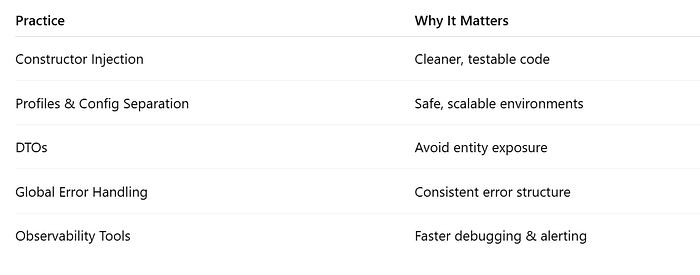
🧵 Conclusion
🧠 Final Thoughts
Spring Boot gives you the power to ship fast — but with great power comes great technical debt (if you're careless).
Follow these best practices, and you'll:
- Write maintainable code.
- Avoid painful bugs in prod.
- Earn the respect of your fellow devs (and your future self).